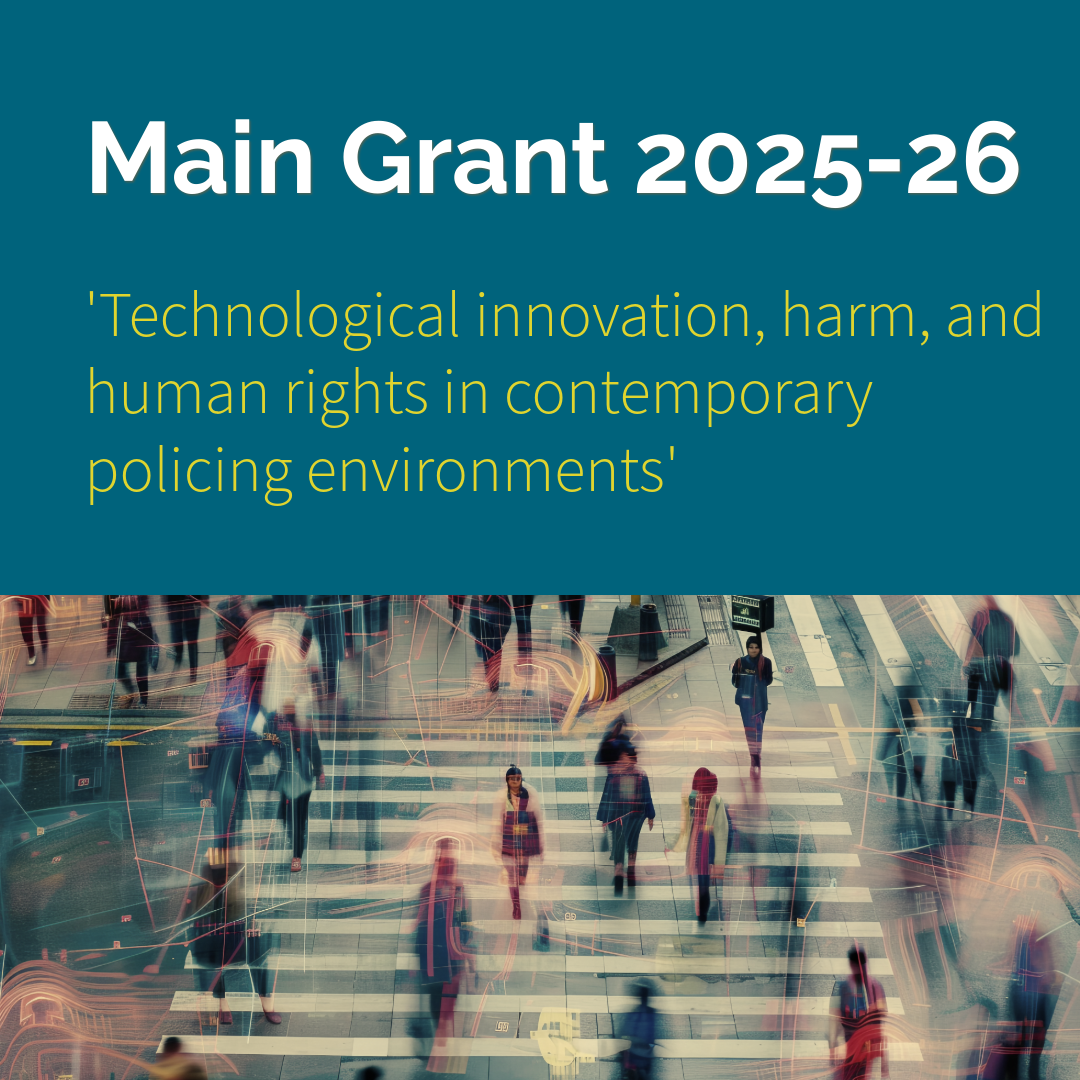
SIPR is providing £40,000 to fund minimum of 2 research projects exploring ‘Technological innovation, harm, and human rights in contemporary policing environments’
Focus of grant
This call aligns with our newly launched digital policing and technological harms network. Rapidly developing technological innovation presents a range new capacities to policing organisations. Technologies like Live Facial Recognition and Artificial Intelligence promise to improve effectiveness with automation, and enhance capacity to respond to changing local, national, and global threats and technological harms in an era of ‘urgency’. However, their adoption must be pursued cautiously to mitigate any risks they may present to policing organisations, Scotland’s communities, and to ensure the preservation of human rights.
The Scottish Institute for Policing Research invites applicants to propose a programme of work which critically assesses the implications of new technologies deployed in both offending or policing contexts with a particular focus on human rights, ethics, and emergent forms of harm that technological innovation may alleviate or exacerbate. Technological innovation should be understood as broadly defined (e.g. UAVs, Live facial recognition, artificial intelligence, digital platforms and services). We are interested in funding projects that pursue research with policed communities and/or police organisations which reveal or address harms associated with new technologies, how they are used to commit crime or how they may be leveraged in policing contexts.
If you would like to discuss the suitability of your project idea to ensure it would be appropriate for the remit of this call, please contact either Dr Shane Horgan (s.horgan2@napier.ac.uk, SIPR Associate Director), Dr Andrew Wooff (a.wooff@napier.ac.uk, SIPR Director).
Information for Applicants
Eligibility
Applications are welcomed from researchers with expertise in new technologies in crime and policing, including (but not limited to) some of the issues identified above.
Projects are expected to align with the SIPR Strategic Research Priorities and should be cognisant of the latest Strategic Police Priorities / Police Scotland 2030 vision.
Co-production or co-creation with organisations or communities is welcome but not required, however, the Principal Investigator (PI) must be based at a SIPR member University and this HEI must be the administering organisation.
Value
A total of £40,000 will be available. The maximum grant value from SIPR per application will be £20,000, though smaller applications are also welcome. We welcome proposals which include co-funding from other sources (which may bring the total project value above £20,000).
Assessment Process
To ensure that all funded projects are of high quality, all applications will be subject to a robust assessment process. The review stage will include assessment by an independent panel comprising of senior academics and policing personnel.
Applications will be assessed against the following criteria:
- The extent to which the proposed project meets knowledge gaps in relation to new policing technologies and emergent technological harms;
- The suitability of proposed team (i.e., Project Lead/ Principal Investigator and Co-Investigator’s experience and expertise in the field of study)
- Project’s feasibility and value for money (i.e., a project’s ambition and ability to deliver outcomes to budget and within timescales); and
- The potential benefits/impact (i.e., project legacy and potential to influence police and practice).
Application Process
Applicants are required to complete the relevant application form including the following information:
- Description of team – one paragraph per named investigator which details experience and expertise in the proposed topic including per named investigator;
- Details of the project including background, aims, objectives, partners/ collaborators, methodology, and timeline;
- Proposed budget including a brief justification of resources required; and
- Clear indication of the expected outputs and impact of the project, detailing the potential contribution of the project to the development of the evidence-base, or of policy or practice related to the themes, and how you propose to capture and measure the impact of the project.
Where the project requires access to Police personnel or data, a letter of support from Police Scotland (or the relevant external body) should be sought. Please ensure you contact Police Scotland’s Research and Strategy Team (AcademicResearch@scotland.pnn.police.uk) as soon as possible to ensure the project’s feasibility. Please be advised, Police Scotland will require at least three weeks’ notice for all requests.
Terms
Only one application is permitted from any applicant for this call.
Projects should aim to be a maximum of 12 months in duration, commencing no later than 31 July 2026 and completed no later than (i.e., acceptance of final research report) by end of July 2027.
Successful applicants will be required to enter into a funding agreement with SIPR). 50% funding will be provided on commencement of the project with the remaining 50% provided on delivery of the final report. The final research report will be published by SIPR and SIPR must be acknowledged in all media and publications resulting from the project.
Applicants will also be required to report where this funding has enabled the generation of external income as well as where this project has been included as an impact case study.
Timetable
The dates below are indicative only and may be subject to change.
| Timeline/Milestones | Date |
| Call Launched | 17 April 2026 |
| Deadline to Provide Notification of Intent to Apply | 8 May 2026 |
| Deadline to Submit Applications | 29 May 2026 |
| Applications Sent to Award Panel | w/c 1 June 2026 |
| Award Panel Meet | w/c 8 June 2026 |
| Decisions Announced | w/c 15 June 2026 |
| Latest Start Date for Successful Projects | 31 July 2026 |
| Latest Completion Date for Successful Projects | End July 2027 |
Ineligible costs
These grants will not cover the following costs:
- Core funding for institutions. In terms of overheads awards are generally not granted on a full economic costing basis;
- Endowments;
- Individual items of equipment;
- A shortfall resulting from a withdrawal of or deficiency in public finance;
- Sites, buildings or other capital expenditure; and
- Student tuition fees or stipends.