Dr Grant Barclay and Dr Alicia Heys
Funded by SIPR’s Early Career Researcher Grant Scheme
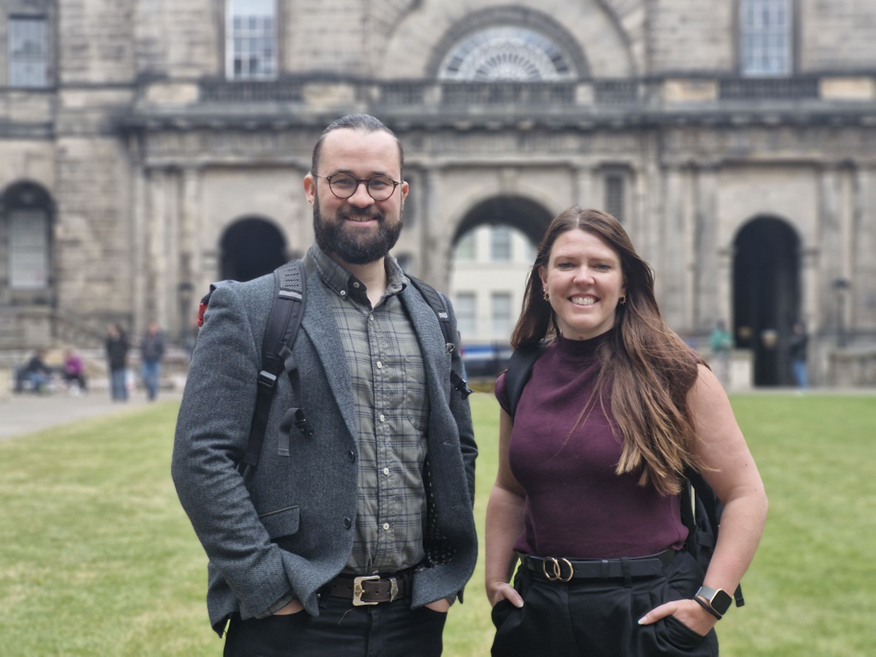
On Monday 19 May, we were pleased to host a roundtable at the University of Edinburgh on ‘The Criminal Exploitation of Victims of Modern Slavery: Comparing the Scottish and English & Welsh Responses’. This workshop brought together criminal justice practitioners and academics from across Scotland and England & Wales, with attendees including representatives from Police Scotland, the policy and engagement team of the Crown Office and Procurator Fiscal Service (COPFS), policy advisors from Crown Prosecution Service (CPS), police from England & Wales, as well as solicitors, social workers, and researchers in the field of modern slavery and human trafficking (MSHT).
The event was supported by the Scottish Institute for Policing Research (SIPR) through its Early Career Researcher Grant Scheme, and provided a valuable opportunity to explore the similarities and differences between legal frameworks, and to share learning across jurisdictions.
Comparing Legal Frameworks: Scotland and England & Wales
The discussion focused on the contrasting ways each jurisdiction approaches victims of criminal exploitation who have committed offences as part of their modern slavery or human trafficking experience.
The relevant legislation derives from the Council of Europe Convention on Action Against Trafficking in Human Beings of May 2005, known as the Warsaw Convention. Article 26 imposes an obligation on signatories to provide the possibility for national authorities not to impose penalties on victims of trafficking or modern slavery for their involvement in unlawful activities to the extent that they have been compelled to do so. This principle of non-punishment was expanded when the Warsaw Convention was adopted into EU law by Directive 2011/36. Article 8 of the Directive requires member states to take “necessary measures to ensure that competent national authorities are entitled not to prosecute or impose penalties” on such victims for their involvement in criminal activities which they were “compelled to commit as a direct consequence” of being trafficked. This has led to various national legislative reforms in the constituent jurisdictions of the UK which each in some way address this more general principle by intervening before the sentencing stage of the criminal justice process. Legislation in England & Wales has created a bespoke defence under section 45 of the Modern Slavery Act 2015 (s45 defence). This defence applies to adults who have been compelled to commit an offence, and children who
have acted as a direct consequence of being victims of modern slavery or human trafficking. In contrast, section 8 of the Human Trafficking and Exploitation (Scotland) Act 2015 creates an obligation on the Lord Advocate, as head of COPFS in Scotland, to issue and publish instructions for prosecutors regarding the prosecution of victims of human trafficking or exploitation who are alleged to have committed criminal offences.
In Scotland, determination of criminal liability for potential victims of trafficking is integrated into early prosecutorial decision-making. Under Instructions from the Lord Advocate (via Section 8 of the Human Trafficking and Exploitation (Scotland) Act 2015), COPFS considers whether suspects are victims of trafficking, and in turn whether their offending was compelled (or caused as a direct consequence in the case of children) before a prosecution is brought.
By contrast, in England & Wales, the statutory defence under Section 45 of the Modern Slavery Act 2015 applies at trial, meaning that while decisions are still made at the prosecutorial level about victim status and its influence on offending before decisions are made, cases may be more likely to proceed to court before a final determination is made on whether the individual should be held criminally liable. Participants suggested this may be happening with some frequency, pointing towards a discrepancy between policy and practice.
From a safeguarding perspective, the Scottish model was viewed by the participants as preferable, helping to divert victims from the criminal justice process altogether. Broadly speaking, it was felt that England & Wales follows the non-punishment principle derived from international instruments, while Scotland appears to align more closely with a non-criminalisation approach.
The Role of Multi-Agency Collaboration
A key theme arising from this legal divergence between jurisdictions was the significance of multi-agency cooperation. Participants praised the close working relationship between Police Scotland and COPFS, particularly the ability of COPFS to direct further investigative work when there are indications of trafficking. This coordination helps ensure victim safeguarding remains a core focus throughout.
This point was highlighted by comparing the position in England & Wales, where constabularies have varying degrees of connection with CPS in relation to matters of human trafficking and modern slavery.
There was also praise for the Scottish approach in maintaining close relationships with Non-Governmental Organisations to ensure that victims of trafficking have adequate support on leaving custody, therefore reducing the likelihood of them returning to their traffickers.1
Addressing Knowledge Gaps and Training Needs
Despite the strengths of the Scottish system, participants noted that knowledge gaps among frontline officers continue to hinder the identification of potential victims. Effective institutional processes still rely on individual officers recognising the signs of MSHT when out in the field.
Police Scotland has recently introduced training on MSHT for probationary officers. However, more experienced officers may not always receive the same level of ongoing
professional development, leading to missed opportunities for referral or misjudged assessments.
Participants also highlighted that poor-quality referrals to the National Referral Mechanism (NRM)2, often lacking sufficient context or detail, can compromise the process and outcomes for potential victims.
Challenges in Victim Engagement
Another barrier to identification discussed at the workshop is that many victims do not recognise themselves as victims, particularly when exploitation has been normalised through repeated experience. This complicates the process of obtaining informed consent for NRM referral, especially in adult cases.
Conversely, scepticism within the system can lead to premature or incorrect conclusions about an individual’s victim status. The criminal justice system is uniquely placed to make authoritative determinations, which can inadvertently re-traumatise individuals when their experiences are dismissed. There was a worrying example from one participant who recalled a judge telling an accused who had raised the s45 defence that they were ‘too old’ to be relying on the defence, thus highlighting a concerning
Participants stressed the importance of maintaining open-mindedness in interactions with individuals who may be victims, and the need to foster strong, consistent engagement with victim support services, even where legal thresholds for formal recognition are not met.
Looking Ahead: Strengthening Scotland’s Response
Scotland’s unitary policing model provides a strong foundation for developing consistent, specialised responses to complex issues like human trafficking. However, maximising this strength requires investment at the individual level, particularly in officer training and awareness. Funding must continue to be made available to allow Police Scotland staff to complete specialist modern slavery training that will enable them to improve their practice and identify victims. In addition, the Human Trafficking Champions are an important pre-existing resource, offering specialist advice and helping to ensure MSHT indicators are not overlooked during routine policing.
Summary and Next Steps
At the outset there was general intrigue and concern that Scotland did not have a dedicated statutory defence. However, as the discussion progressed, it was evident that, even without a stipulated defence, practice in reality was effectively accounting for situations in which victims of human trafficking had committed criminal offences. Praise was given to the approach of establishing links between trafficking and the criminal offence prior to pursuing a prosecution, the consideration of victimhood regardless of the crime (as opposed to England and Wales where there is a list of over 100 crimes for which the defence cannot be used), and no requirement of a ‘reasonable person’ test where, in England and Wales a jury must consider whether they deem that a reasonable person in the same situation would have undertaken the same actions.
By the conclusion of the workshop it was evident then that Scotland had a solid approach to dealing with incidences of victims of human trafficking who had committed offences, even without a dedicated defence. However, while the strong legal frameworks and institutional partnerships in Scotland do play a crucial role, identification ultimately hinges on the knowledge, awareness, and confidence of individual officers and legal representatives, and it
is essential to ensure that this knowledge remains up to date.
The full summary of proceedings is now available to download, alongside a podcast outlining key discussion points.
Read the full report here: https://bit.ly/4aIYrBq
Listen to the podcast here:https://bit.ly/4ab2arj